Showing posts with label poetry and rhyme. Show all posts

What's an Og? by Mary Barry

Learning about letters and the sounds they make... phonics/phonetics... are important parts of learning how to read.  Engaging children in wordplay with rhyming words is one strategy parents and teachers can use to help their students become more proficient in reading.  In today's guest post, children's author Mary Barry talks about her recently released children's book called What's an Og?... a book full of wordplay and rhymes for the /og/ sound. Keep reading to learn about What's an Og? and how Mary Barry came up with her idea for the story!

Children will learn to read and practice words with the /og/ sound while reading What's an Og by Mary Barry. Phonics. Rhyming book. Preprimer/Primer.

This is a guest post by Mary Barry. To learn more about guest posts, please visit the Authors, Publishers, and Sponsors page.  Disclosure: Affiliate links to Amazon are included in this post.
 

School is More Than a Building by Kelley Donner

Are you looking for a new children's book to read to your students during the first week of school? A book to make them feel positive about coming back to school? A book to make them feel like a valued member of the school community? Children's author and illustrator Kelley Donner published her children's book School is More Than a Building in May and it would be an excellent read for that first week. In this blog post, Kelley Donner writes about her new book, where the inspiration for the book came from, and the resources you can download to go with it. Keep reading to learn more about School is More Than a Building!

School is More Than a Building by Kelley Donner

Disclosure: Affiliate links to Amazon are included in this post.
This is a guest post written by Kelley Donner. To learn more about guest posts, please visit the Authors, Publishers, and Sponsors page.

Black Bear Goes to Washington and Run Like a Sled Dog by Denise Lawson

There are two famous sled dog races that take place in Alaska each year, the Yukon Quest and the Iditarod. The Iditarod is held each year on the first Saturday in March. Teams of sled dogs and mushers gather in Anchorage, Alaska this and make the 1,000-mile trek to Nome, Alaska. The Iditarod is a challenging race that takes 8 to 15 days to complete. The Yukon Quest which is also 1,000 miles is considered to be even more challenging than the Iditarod because it takes place earlier in the year when it's colder and darker. It runs between Fairbanks, Alaska and Whitehorse, Yukon (Canada), and takes 9 to 24 days to complete. The race is unique in that it takes place in two countries. Each year the direction of the race alternates so Fairbanks and Whitehorse take turns being the start and finish line. The Yukon Quest is so challenging... it is considered to be the toughest sled dog race in the world!

Author Denise Lawson recently adopted a retired sled dog named Black Bear.  Black Bear was born in Eagle, Alaska and was a lead dog in the 2009 Yukon Quest.  She also led dog teams on remote wilderness expeditions for many years.  How cool is that?  When Black Bear was ready to retire and needed a forever home, Denise Lawson and her family welcomed her into theirs.  Denise Lawson loves Black Bear so much, she wrote an entire series of children's books about her.  The first book in the series is Black Bear Goes to Washington and the most recent book is Run Like a Sled Dog.  Keep reading to learn more about these two books, how you can use them in the classroom, and more about Black Bear herself!

Black Bear Goes to Washington and Run Like a Sled Dog by Denise Lawson are two children's books inspired by the author's dog... a retired sled dog.

If you are looking for the FREE Sled Dog Research printable, it has been moved to the blog post Fun Facts About Sled Dogs.  Disclosure: Affiliate links to Amazon are included in this post.

The Adventures of Scout by The3engineers

A few weeks ago I wrote about the book Saving Planet Earthly by our friends at ClimateScience.  Saving Planet Earthly introduced the important topic of climate change to children.  It explained what climate change is, what causes it, and how we can minimize its effects.  

Like ClimateScience, the3engineers is another nonprofit organization whose mission is to educate children about environmental issues and to encourage them to make small changes that will add up to make a huge difference.  The3engineers have written a series of audiobooks called The Adventures of Scout, the first three of which... Plastic On Our Beaches,  The Bees Are Missing, and Endangered Animals... are currently available on their website.   Keep reading to learn more about the3engineers, their mission, and how they came up with the idea for Scout!

Learn about The Adventures of Scout, an environmental audiobook series for children written by the3engineers. Endangered animals, plastics, and bees.

Please Don't Tell Cooper He's a Dog by Michelle Lander Feinberg

Anthropomorphism is the attribution of human characteristics and behavior to animals and objects.  When authors use anthropomorphism in their books, we see animals and objects behaving like humans.  They walk, talk, and think the way people do.  Anthropomorphism is a fun literary technique that tickles the imaginations of children and keeps them engaged with what they are reading.  

Please Don't Tell Cooper He's a Dog by Michelle Lander Feinberg is about a beloved family pet Cooper who thinks and acts like a person.  What does Cooper in the story?  How does he behave?  Keep reading to learn about Please Don't Tell Cooper He's a Dog and how you can introduce anthropomorphism to your students!

Learn about anthropomorphism, personification, and reality vs. fantasy by reading Please Don't Tell Cooper He's a Dog by Michelle Lander Feinberg.

Disclosure: Affiliate links to Amazon are included in this post.

Marvelous Masks by Nicole Billick

Using children's books to introduce vocabulary words to young readers is an important strategy used regularly by preschool and elementary school teachers.  Children's books can expose readers to new words that don't ordinarily come up in day-to-day conversation.  For example, in Marvelous Masks by Nicole Billick, readers learn about the different types of masks and who wears them.  Some of the vocabulary words in Marvelous Masks will be familiar to readers... such as cowboy, doctor, and superhero... but other vocabulary words... such as chemist and blacksmith... may be new to them.

In this guest post, author Nicole Billick talks about her book Marvelous Masks and where she got the inspiration to write it.  She also describes some activities parents and teachers can use with their children and students when they finish the book.  Keep reading to learn more about Marvelous Masks and the author!


The following is a guest post written by Nicole Billick.  To learn more about guest posts, please visit the Authors, Publishers, and Sponsors page.
Disclosure: Affiliate links to Amazon are included in this post.

Love Grows Love by Lauren Grabois Fischer

Empathy is at the heart of what it means to be human. It’s a foundation for acting ethically, for good relationships of many kinds, for loving well, and for professional success. And it’s key to preventing bullying and many other forms of cruelty.
-5 Tips for Cultivating Empathy, Harvard Graduate School of Education

Empathy is the ability to be aware of and sensitive to another person's thoughts, feelings, and experiences.  It's the ability to put yourself in their shoes and is the foundation for kindness, tolerance, and compassion.  It's also an emotional skill that needs to be taught.  

One of the ways teachers and parents can help children learn empathy is through reading and discussing empathetic children's literature.  Reading Love Grows Love by Lauren Grabois Fischer is a good book to use when starting that discussion.  In Love Grows Love, we see children... and flowers... experiencing different emotions.  Their faces clearly depict how they are feeling.  Children will be able to look at the illustrations, identify how each child and flower are feeling, and see a cause and effect relationship between the children's emotions and the flowers'.  Keep reading to learn more about Love Grows Love and how you can use it in your classroom!

Love Grows Love by Lauren Grabois Fischer sends a message of love and empathy. Read Love Grows Love then make some seed paper to grow some love!

If you are looking for the directions to making seed paper, they have been moved to the blog post How to Make Seed Paper Hearts.  Disclosure: Affiliate links to Amazon are included in this post.

Goo on My Shoe by Jacqui Shepherd

When teaching reading to young or struggling readers, teachers often use poetry as one of the strategies to help them.  There are a lot of reasons why we use poetry:

🍎 Poems tend to be brief and easier to read.
🍎 Repetitive reading and mastery of poems build students' confidence.
🍎 Choral reading of poems encourages hesitant students to read out loud with the others.
🍎 Teachers can use poetry to teach word recognition skills and build vocabulary.
🍎 We feel emotions when we read poetry.  Talking about those emotions helps to build a better understanding of ourselves and others.

Goo on My Shoe by Jacqui Shepherd is a story for young readers that is written in poetic form.  It has a likable main character and a storyline that will keep students engaged and motivated to read.  Read on to learn more about Goo on My Shoe and how you can integrate it into your language arts lessons.  There is even a simple goo recipe for you to make with your students!


Learn about rhyming words, words with the /oo/ sound, and how to make your own goo with the book Goo on My Shoe by Mari Schuh.

Disclosure: Affiliate links to Amazon are included in this post.

Make a Wish on a Fish by Jennie Wiley

Rhyming words is one of the first skills children learn as early readers.   Being able to rhyme words teaches children about how language works, how to identify sounds within words, and can even help children in decoding the words they read.  Rhyming is sometimes a predictor of how well children will learn to read.  The more children listen to poetry and participate in activities like fingerplays, the easier it will be for them to connect and make sense of what they're reading.  Make a Wish on a Fish by Jennie Wiley is a book written as poetry and with lots of rhyming words.  Keep reading to learn more about Make a Wish on a Fish and how to use it in your reading lessons.

Language arts lesson about reality vs. fantasy and rhyming words for young readers using the book Make a Wish on a Fish written by Jennie Wiley.

Disclosure: Affiliate links to Amazon are included in this post.

What's My Instrument? by Johnny Oddsocks

I need to lay something out there for everyone to see.  I am a HUGE advocate for keeping music education in our schools, so when the author Johnny Oddsocks asked if I would be willing to write a blog post about his book What's My Instrument? I quickly agreed.  In his book, Johnny Oddsocks tells the story of Marilyn the Mongoose who wants to start a band and introduces kids to a variety of musical instruments.  Keep reading to learn more about What's My Instrument? and how you can integrate it into your language arts or music lessons at school.

Have fun learning about musical instruments with the story What's My Instrument? written by Johnny Oddsocks. Integrated language arts lesson plan.

Disclosure: Affiliate links to Amazon are included in this post.

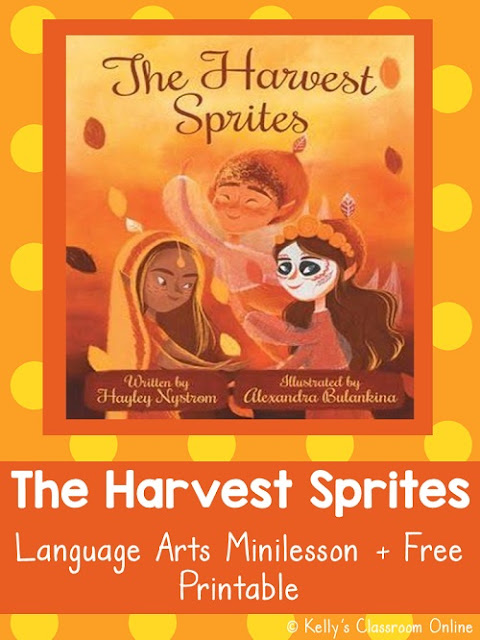
The Harvest Sprites by Hayley Nystrom

Call me silly, but I believe there is something wonderful and magical about autumn.  I love the colors in the trees, the crispness in the air, wearing my warm sweaters and socks, wrapping myself in a blanket, and snuggling in with a good book.  I love the tastes and smells of freshly made apple cider and cinnamon doughnuts.  And I especially love the big bonfires and making s'mores with my family and friends.  Autumn is my favorite time of the year!

I recently found The Harvest Sprites by Hayley Nystrom.  I fell in love with it right away!  It's a fun book with beautiful illustrations of everything autumn has to offer.  Read on to learn more about The Harvest Sprites and how you can integrate it with your lessons at school.

Learn about the signs & symbols of fall with The Harvest Sprites by Hayley Nystrom. Students will match characters of the book to the symbols of fall.


Disclosure: Affiliate links to Amazon are included in this post.

Grow! How We Get Food from Our Garden by Karl Beckstrand

A couple of weeks ago, I wrote a blog post called How to Grow Celery from Food Scraps.  In that post, I talked about the disconnect children have about their food and described a science activity you can do with them.  Since then, I learned about a new book hitting the market in October 2020.  It's called Grow!  How We Get Food from Our Garden by Karl Beckstrand.  Grow! would be a good book to read with your students to help them realize where their food comes from.  Yes, food does come from the grocery store.  But before it gets to the grocery store, it was grown in someone's garden.  Read on to learn more about Grow! and to get ideas on how to use it in your classroom.

Learn where our food comes from with Grow! How We Get Food from Our Garden by Karl Beckstrand. Children learn that the food we eat comes from gardens.

Disclosure: Affiliate links to Amazon are included in this blog post.

10+ Children's Books about the Chinese Moon Festival

xī wàng míng yuè néng bǎ wǒ mén dě zhù fú hé huān lè dōu dài gěi nǐ.
希 望 明 月 能 把 我 们 的 祝 福 和 欢 乐 都 带 给 你。

May the full moon bring blessings and happiness from our home to yours!

It is almost time for the Chinese Moon Festival, also known as the Chinese Mid-Autumn Festival.  This festival is always celebrated on the 15th day of the 8th lunar month when there is a full moon.  On this special day, people gather with friends and family, give thanks for bountiful harvests, and say prayers for a good future.  It's also a time filled with colorful lanterns, music, games, and... of course... mooncakes!  Read on to discover 10 children's books about this joyous occasion.

A compilation of 10+ children's books about the Chinese Moon Festival, what it is, who celebrates it, and how it's celebrated. Fiction and nonfiction.

Disclosure: Affiliate links to Amazon are included in this post.

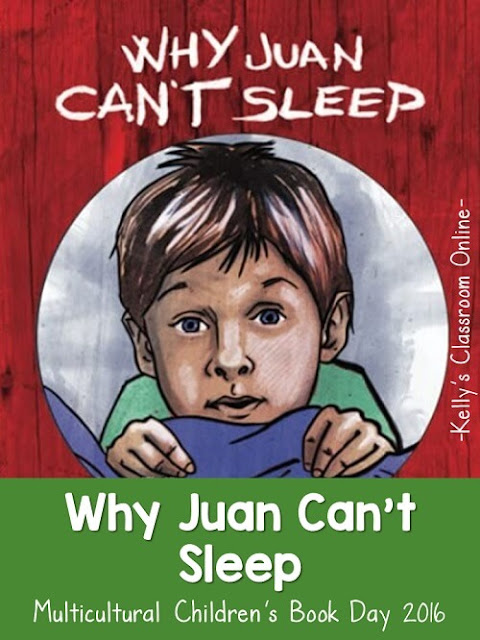
Why Juan Can’t Sleep by Karl Beckstrand

Hello, friends! Welcome to Multicultural Children's Book Day 2016. Multicultural Children's Book Day (also known s MCBD) is an annual celebration of multicultural children's literature and some of the authors who write these books. This blog post takes a look at Why Juan Can't Sleep by Karl Beckstrand. Keep reading to learn more about Why Juan Can't Sleep and for a quick minilesson you can use in your classroom.

Learn about stream-of-consciousness and story elements while reading Why Juan Can't Sleep, a children's book written by Karl Beckstrand.